I
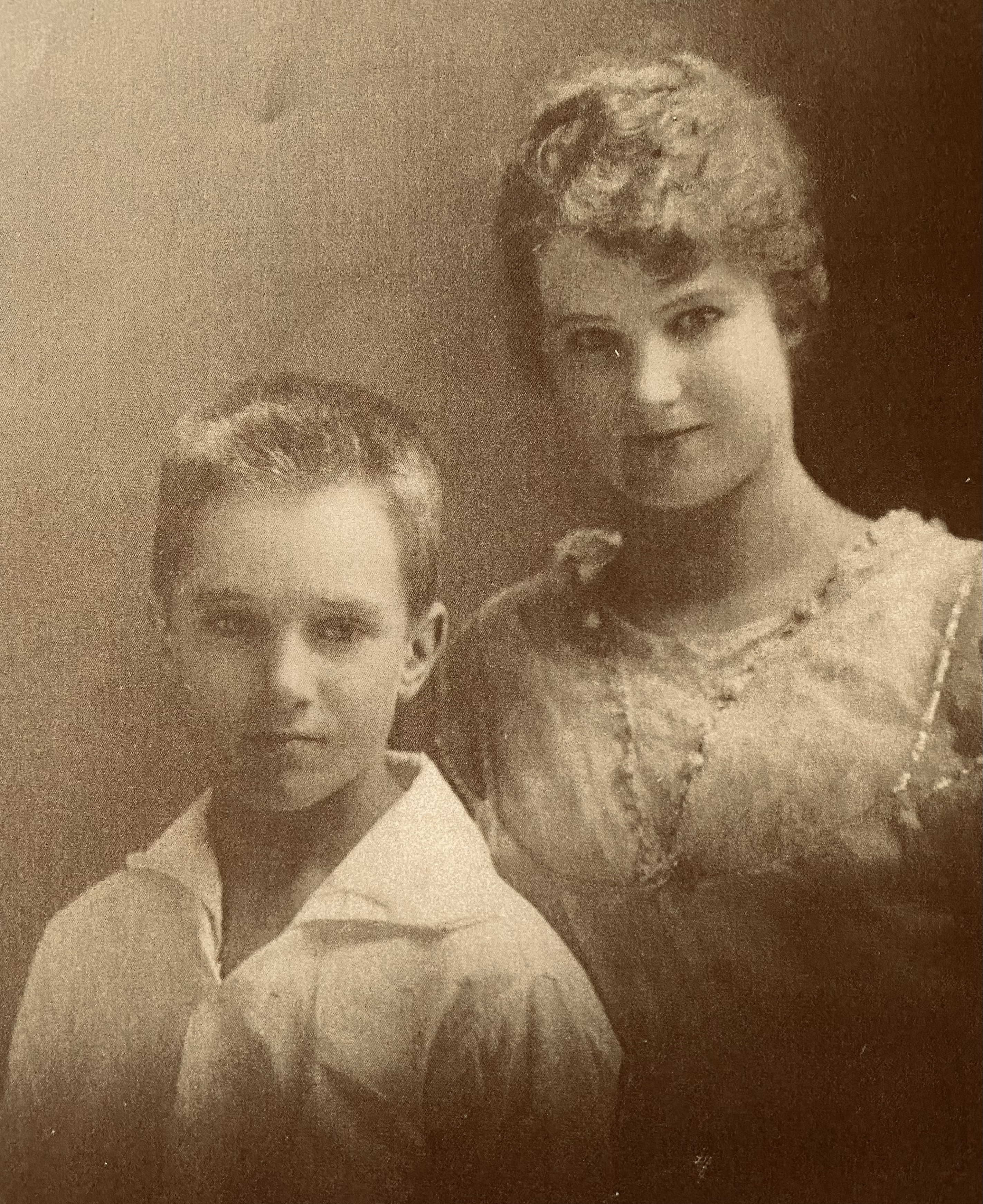
My paternal grandfather, James Harold Cantwell, in his last years, between about 1969 and 1972, his mind and body in sharp decline with chronic illness, wanted to write a book. In the one, single instance he writes about his health it is with panic—“I haven’t any time to spare.” And he did run out of time, dying at age sixty-seven with the book unfinished. It was not for lack of effort. He worked on it for years, writing almost every day, isolated in his own bedroom/study, scribbling away for hours in dozens of spiral notebooks that piled up around him. As a child of nine or ten, I remember seeing him hard at it, bent over his desk in a kind of trance. Though I knew not to disturb him, I peeked in a couple times anyway, my curiosity aroused by a sense that my family didn’t approve. I wondered why.
I can remember the frustration and concern in my grandmother Afton’s voice as she whispered about “his writing” to others. She defended him and tried to give him space to work, but she didn’t really understand what he was doing. She would say things like: “What’s he up to all this time?” and “I get glimpses of what he writes and I don’t understand it and wonder if he understands it himself.”
She was right. The notebooks are baffling. Still, out of loyalty, she kept them for years after he died, moving them with her to a new home. But when she tried to read them, it would make her sad and confused. He seemed to write about everything in the world except their own family life. I happened to be with her on the day she had finally decided to let them go. I could tell she was torn about the decision. We both felt a mix of loyalty and burden. Responding to an inner pull, I asked her to give the notebooks to me to see if I could decipher them. She was relieved and grateful someone would try. And I made many attempts over the years, but decades passed between attempts. I was living my own life after all—graduate school, girlfriends, my profession, my own writing, and most important, my marriage and family. More than once I considered letting them go. But something held me back.

What he left behind was a stack of fifty-five steno notebooks, spiral-bound at the top, which are filled with barely legible script written in ballpoint pen or fading pencil—written on both sides of the pages, written from front-to-back and then from back-to-front. There’s no indication which notebook comes first or really any trace of chronology at all. The writing starts close on the left side of each page and goes as far as possible to the right edge. Many pages are erased, then written again. He cycles through a series of childhood traumas—many times described in exactly the same words, but also in dozens of variations. He surrounds these memories with diverse abstract ideas and facts about world religious history and doctrine, speculative theology, physics, astronomy, ancient philosophy, archeology, farming economics, and anthropology—to name just a few. It’s as if these random notes unconsciously shield him from the acute pain of his most closely held childhood memories.
In short: The notebooks are a vexing palimpsest—this nearly inscrutable manuscript with its multiple and conflicting written messages, erasures and subtexts that overlay and play off each other in unexpected ways.

Why try to unravel them now? I’m not certain what drives me to it. Perhaps because I’m a writer myself? Or I’m at the very same age when my grandfather was trying to write his book? I do now find myself in his shoes for the first time in my life. Up to this point, even well into middle age and beyond, I have always thought of myself as a young man. It’s a game of denial I have played with time. Doesn’t everyone do this? But now I can’t escape the reality that my own memory and health are beginning to slip. Could it be I have carried these notebooks with me for more than forty years—moving them from apartment to apartment, from house to house—for just this moment in my own life? My grandfather knew his health and capacity were fading. He felt an urgency to get to the heart of things. But what was it? He wanted to share something crucial, bear witness, to explain himself. But what did he most need to say? I’m finally compelled to find out.
All my adult life I have written essays and stories, and kept journals. This has been my creative space, my instinctive survival skill, my method for coping with whatever comes my way. I have always believed I could live a better, richer life if I observed and gathered experience—and then relived it and made sense of it by writing. Yet every time I put pen to paper, I feel a wave of doubt and I ask myself why I do it. Why does anyone? Is it a fear of disappearing? Is it egotistical? Why are my memories and impressions important at all? Perhaps, at the core, it is a natural human impulse to say: I lived. I was here. I had a look around. I paid attention.
This impulse to capture our memories before it’s too late is near universal. The renowned journalist Ryszard Kapuscinski describes this desire in his book Travels with Herodotus: “Man knows, and in the course of years he comes to know it increasingly well, feeling it ever more acutely, that memory is weak and fleeting, and if he doesn’t write down what he has learned and experienced, that which he carries within him will perish when he does.”
The poet Clarice Short says the closest we can come to permanence is a long-held memory passed on. In The Writing Life, Annie Dillard goes much farther to say it’s selfish to give in to our doubts and withhold: “The impulse to keep to yourself what you have learned is not only shameful; it is destructive. Anything you do not give freely and abundantly becomes lost to you. You open your safe and find ashes.” We read, she declares, “in hope that the writer will magnify and dramatize our days, will illuminate and inspire us with wisdom, courage, and the possibility of meaning.” When we connect with a writer, something miraculous can occur—a power that “seizes our lives and reveals us startlingly to ourselves as creatures set down here bewildered.”
I don’t think we have to be reading Tolstoy or Shakespeare to experience this connection and resonance. It can be even more powerful reading the attempts of ordinary people—especially our own people—no matter how chaotic and artless those attempts may be.
In one battered notebook, under the title, “What I Have Been Trying to Say,” my grandfather acknowledges what a mess his attempt at a book is—as if apologizing across time. Since I’m the only one reading the notebooks, it feels like he’s talking directly to me. He admits, “I haven’t been trying to give my thoughts in chronological order, but in the order they came to me. The summation will come at last.” Though a summation is slow to appear, I’m compelled to look harder, because of what he writes a few lines later: “What I had in mind was a little description of why I think I am like I am.”
My grandfather didn’t know how to do this. He simply started with what he was thinking at the moment and went from there. He did this day after day, for years. Repeating the same abstract ideas, obsessions and random facts along with fragments of childhood memory until a captivating story of a family in the early 1900s begins to reveal itself. Even his frequent digressions from this family story reveal much about who he was.
II
Since there is no obvious place to start, I begin at random with one notebook about the Book of Genesis—Adam and Eve in the garden, Lucifer the fallen angel, Cain’s murder of his brother Abel, the days of Peleg when the earth was divided, Noah and the flood, the City of Enoch taken into Heaven, the Tower of Babel, and on. At least half of the notebooks contain extensive passages on religious topics—with underlined titles like: “The Holy Spirit,” “Father Abraham,” “The Gospels of the New Testament,” “John the Baptist,” “The Rest of the Story of the Birth of Jesus,” and also many sections about his own Christian tradition—“My Conception of Mormonism,” “The Words of Jesus in The Book of Mormon,” and “The First Vision of the Prophet Joseph Smith.” There are hundreds of references to prominent Mormon theologians, such as B.H. Roberts, James E. Talmadge, John A. Widtsoe, and Hugh Nibley. I think many of these pages are notes for a Sunday school class he taught for more than thirty years in his small community church in northern Utah. Many times, he references books and scriptures with the words, Read this! or Start here. As if he had marked a passage to read to the class. But by no means is he limited to religious topics. The following sample of fragments from one notebook illustrate his exploration of pre-history—just one example of dozens of topics he returns to throughout the notebooks:
History was either prehistory or written history | it begins in Mesopotamia, in the delta of alluvial soil—a fertile grassland—between the river Euphrates on the west and the river Tigris on the east | many came to Babylon to learn and to trade | ruthless rulers intent on capturing the earth and its resources | prehistory depended on what it could gather from the earth’s surface or dig out of the ground | and the fossil records of all kind of things that have lived and perished, leaving their dead bodies behind to be studied
Perhaps, most of all, his notebooks explore the intersection of science—especially physics—and spiritual beliefs. For him, spiritual and scientific knowledge were one and the same. Knowledge was knowledge, regardless of the way you came “to know.” In one notebook passage he writes about cosmic rays, the inner world of the atom, cloud chambers, anti-matter, quarks, atomic fission and the light of stars—and then connects these ideas to the concept of the Holy Spirit. He asks: “What did God make His entire creation out of? Did God cart it [the material] in from some unseeable place, beyond the reach of Palomar? I do not think so. It seems to me so much easier to think the material is all around . . . the Holy Spirit.”
Here are some representative fragments which combine scientific and spiritual concepts:
Man is a part of something so vast | Space is endless | Our universe contains as much or more anti-matter than physical matter | Wherever there is space, used or unused, it is crammed full of Holy Spirit | All things could possibly be made of light | Our physical world is the product of the spiritual world | Could there be such a thing as spiritual hydrogen or a spiritual atom? | The world I feel sure was first made out of spirit | The Holy Spirit fills the immensity of space . . . and can never exhaust itself.
And on it goes. No less than a thousand written pages of what he calls a “treatise” about the connections between physical matter and The Spirit, and between physical light and spiritual light. This book within his book is not something I could begin put to order. I had to set it aside. But I want to acknowledge the depth and scope of his attempt and my sense of how much joy and relief it must have given him to try. It was his theory of everything. Even though he couldn’t capture his theory in words, he could imagine grasping it and so he never stopped reaching.
Another obsession—accounting for many pages in the notebooks—was the history of astronomy. He read popular science books, quoting them at length and speculating about what he learned. He would also describe these theories about the workings of the universe to anyone who would listen. Most family members saw all this chatter as evidence of his mental decline. And perhaps it was. But I think at the very least it was a persistent echo of a bright and curious mind on the move. Once, when I was about ten years old, I shyly ventured into grandfather’s room where he was scribbling in his notebooks. He smiled in welcome, sat me down next to him and proceeded to explain Ptolemy, Copernicus, Newton and finally Einstein’s Theory of Special Relativity. I couldn’t make sense of any of it except the astronomer’s names, but the novelty of having grandpa’s full attention kept me in the room. More than an hour passed before my father rescued me. “Dad! What are you thinking? This boy can’t understand this stuff.”
III
I remember my parents, uncles and aunts talking about my grandfather in whispers. He would fall into unexplainable bouts of confusion or “spells,” they called them. They worried about his safety and how he might endanger others. There was talk of revoking his driver’s license. He resisted this loss of freedom vehemently. One notebook is filled with ideas about driving safety, including sections on “Road Surface and Skidding,” “Basic Breaking Skills,” “Night Driving” and “Responsibility to Pedestrians.” He was trying to study his way out of losing his driver’s license, but it was revoked anyway.
Grandpa ignored these restrictions and disappeared on clandestine drives, usually within the mountain towns in northern Utah. Once, however, he drove all the way from Utah to Portland, Oregon, where my family and my uncle’s family lived. Grandma Afton called in a panic, “He’s done it again! He might show up any moment.” As it happened, he was in the city for several days before he contacted anyone. He happily wandered about town, talking to young students, which he called “hippies,” downtown at Portland State University. He ate at diners. Visited pool halls. Charmed a lot of casual friends. No one robbed or threatened him, as far as we know. He was having a grand time. Finally, deep in the throes of one of his sudden confusion spells, he called my father from a pay phone. He didn’t know where he was or how to get to our house. He didn’t know where he had parked the car. Somehow, he had enough sense to call. My Dad asked him to describe his surroundings—names of stores, restaurants, street signs—until Dad knew enough to find him.
Grandpa then spent several days at St. Vincent’s Hospital in Portland, where doctors ran inconclusive tests. His confusion would set in, then pass for days, then return without warning. Many times I have been told he once asked for a comb. Then instead of using it, he held the comb out in front of him, at arm’s length, like a mysterious artifact from an archeological dig. He shook his head, “I know I’m supposed to do something with this, but I don’t know what it is.”
This drift between clarity and confusion would continue to varying degrees until the end of his life. My grandmother told me in his last months he didn’t recognize her at all. Then, on one of the last days, his face flushed with recognition when she entered the room. He smiled broadly and looked her in the eye. The clarity lasted only seconds, before he sank back into oblivion, but my grandma cherished this moment.
During this same Portland trip, after he got out of the hospital, grandpa stayed with our family. One afternoon grandpa and I were alone in the house. He came into my room with the keys to our Chrysler sedan. “Steven, Let’s go for a drive.” I was old enough to know a drive with my confused grandpa wasn’t the best idea, but not old enough to tell him what to do. He was a charmer, after all, and persuasive—a mighty will to be reckoned with, and still a powerful physical presence. There may have been a couple of dimes involved to persuade me. Grandpa’s argument made enough sense to me that I went along. My dad, grandpa explained, didn’t really know how to take care of a car and let it sit around too much, which wasn’t good for the engine. We would be doing the car, and my dad, a service. So, we went.
Once out of the neighborhood, when we reached the broader streets on the edge of town, grandpa picked up speed, pushing the pedal to the floor between traffic lights. I must have looked afraid, because he reassured me: “For proper maintenance of an automobile, the engine needs to test its limits. You need to blow out the carbons,” he said. I accepted all this without resistance but not without doubt. He talked about the car engine as if it were a living being with needs and longings like our own. I knew grandpa was the one testing his limits. We raced around town for an hour or so then returned to the house without incident. No police. No accident. No one the wiser. The blow-out-the-carbons ride was our little secret. In fact, I didn’t tell my parents about it until much later, and with that distance my mom could laugh about it and my dad smiled, “Well of course he would do that.”
IV
I was told many times by family members and by complete strangers that my grandfather was a great teacher and scholar, though he never attended college and earned his living as a dairy farmer and by growing sugar beets, and finally as the co-owner of a family lumber business. He was a self-taught intellectual and studied hard all his life. These notebooks are ample proof of his range of knowledge and his voracious curiosity. Though written long after his intellectual prime, the notebooks point to what he once thought and knew—or could have learned had his life taken a different turn. He was better suited to be a college professor than a sugar beet farmer. But the great depression put that dream to bed, along with many others.
In one passage he describes his own father’s concern that he could never stop thinking and asking questions. My grandfather wrote: “Father was disturbed by my inability to keep my mind on what I was doing. I believe the day when he was most alarmed, I was digging a ditch. He warned me, ‘If you do not sometime pin your thoughts down, you will go crazy.’ I immediately explained to him, ‘Dad, I’m digging a ditch. I do not like to dig ditches. Are you going to tie me down to spending the rest of my life engaged in what I do not like to do?’ I saw my plight was hopeless and never interfered any more.’” This sense of frustration with what life had offered him is central to who he was and traces can be seen throughout the notebooks. Even as a child, I had noticed a far away look in my grandfather’s eyes, a look of disappointment that ran deep. I suspect this was mostly about lost opportunity for a scholarly life rather than a working man’s life. But at this point I’m going to set aside my grandfather’s intellectual aspirations and explorations to focus on the family story at the center of his thoughts. This means putting aside hundreds of pages. Yet I hope to stay true to his core intent.
There are about forty pages that have been torn out of the notebooks and stapled in sections. I don’t think these pages fell out by accident, but rather were removed because they focused on the family story and held special importance. Several of these stapled sections are titled “Looking Back,” referring to memories of his childhood. And there is also one particular notebook that details his young life. It is written in a clearer hand and seems to be the oldest of the notebooks. Likely written before his memory and mental clarity began to fade.
Grandpa had high regard for his parents, William and Eliza Jane. He likes to imagine his parent’s beginnings with phrases like, “Two happy people joined in holy matrimony” or “A happy couple just married . . . ,” and then goes on to describe their struggles to make a living and building a family together. He longs for the childhood home they created: “My memory of late keeps slipping back to my first home, when Eliza Jane and William Hamer Cantwell gave to us the nearest thing to greatness a child can conceive of. . . . Without being a child to such parents, you could not possibly appreciate the kind of home they furnished. Complete freedom, impartiality, adoring affection. Would that I could return to that log house.”
In this same notebook, he talks in detail about a time when his father was called on a church mission and spent two years—1908 to 1910—away from his family—serving in “the Great North West.” He said, “Father’s calling was one of the common heroics of the times,” but it was no small matter. The family was still trying to “make a start financially,” and his mother Eliza was left to care for four children, including Grandpa’s youngest sister, Leone, only 18 months old. Grandpa was about four year’s old at the time and his older sisters, Chloe and Venna, were ten and eight. “No little venture it was, a small head of cows must be cared for and milked, calves must be raised to perpetuate the stock, the little farm must provide feed for the cattle and some outside financial help. Money must be had to feed and care for five people at home, taxes must be paid.”
“My mother was a splendid seamstress. People came from all over town to have their clothing made. Mother was equal to the task. The children must not suffer, father must be provided [for], our place must be kept up and her church duties and obligations must be honored.” Grandpa’s Uncle Stephen and others stepped in to help with the farm while his father served his mission. “We were well provided for,” but it was a great sacrifice. My grandfather, even as young as he was, “did his bit.”
He tells one story of when he was five years old: “The beets were being thinned. I was the water boy. I had just carried a short gallon tin of water to the bottom of the field, fifty rods from the house, so Uncle Daniel Littledyke could have a drink. The day was hot and he was dry. He drank his fill and then cast the rest in my face. I fled to the house in tears, bucket in hand. Mother was wise. Instead of taking my part, she gave me an impressive lecture on sense of humor.”
Of his father’s return from the mission field he said, “If I live to ninety years, one event will never fade in sharpness in my memory.” One late spring morning, beet thinning time, he woke up to see “a handsome young man of dark, exciting complexion striding about the house which I never remembered having met before. Mother was aglow with excitement to indicate some special importance he held for her. In a burst of [excitement] mother announced he was my father just then returned from his mission. Pride swelled in my chest that I had been sired by such an impressive person. I followed him like a dog in competition for attention. I soon discovered that ours was to be a comrade association because he invited me to join him in an inspection tour of our small but enticing little farm set up.” In his father’s absence the farm had flourished. All the costs for the mission had been covered. The family had clothing, ample food stored in the cellar, the cows and calves were healthy and paid for. “There was no evidence that things had been set back in any way because of their faithful answer to the call made upon them.” His father was so pleased and excited he couldn’t resist picking up a hoe and starting to block out the beet rows. My six year old grandfather went to work in the beet field beside his father—“excited that [he] was working with a man who just hardly moments before had been revealed as [his] father.”
Though there are only scattered incidents about his parents described in detail in the notebooks, his love and respect for them is unmistakable. He often starts a passage with the heading, “My Gallant Mother.” When his mother died a painful death from cancer at sixty-seven years old, he grieved throughout her long struggle and after her passing. “Everyone helped all they could,” he said, but when it was finally over, he was crushed, “eyes streaming,” and bitter about her suffering and his loss. He ended up dying at the same age of sixty-seven. She had always been his advocate, his teacher. She had been the one who nourished and defended his intellectual inclinations—providing books and time. She had always listened to him, perhaps even favored him, because he was the first son to survive. “She kept me alive with hope and a repentant heart. She was my spur. Her appetite for truth was insatiable. She never wearied of my constant barrage of questions.” He was not at her bedside when she died, but his father and sisters and sisters in law “were there to the last when her breathing stopped.” He continued to feel his mother’s presence in his life: “I have often felt she was my guardian angel. Afton, my wife, is sure she [his mother] has been busy.” This is one of only a few references to his wife, but he also speaks fondly of his romance with her after his mission and how he first met her years before: “I had just returned from a mission to England (1926-1928) . . . I became enamored with a little girl six years my junior. Little did I know a half dozen years prior—when I saw her cross Depot Street on [my] way home, her hair in pigtails—that she would become my wife.”

In an especially moving passage in the notebooks, Grandpa described his father’s grief at Eliza’s death and his subsequent decline. In remembering this, my grandfather recognized his own current circumstances: “In all my life I have never seen a man come apart like father. He worked too hard in the sun until he developed a stroke. From then on it was continuous seizures, each leaving more impairment. . . His mind dwindled into a sort of childishness (a childhood in action) where wit remained but logic nearly departed. I was told in Dad’s pattern [condition] you can be thrown into a happy state or a morbid one. His took the playful state that attracted everyone wanting a laugh. He survived until he was eighty-seven and then passed on.”

V
The strongest family thread in grandfather’s notebooks is the childhood deaths of his brothers and sisters. He comes back to these deaths countless times. Did he fear they would be forgotten? Were these sorrows his most indelible memories? It’s a cliche that early childhood impressions become the most vivid at the end of life, but it was clearly true for him. In these notebooks he lives almost entirely in the twilight childhood world of his parents and his siblings, only rarely referring to his wife, though always with tenderness, and only once or twice to his own children.
He describes himself as “the third boy born and the first to live.” William, his parent’s first child, born in 1896, lived only a month. A second brother, Stephen, born in 1903, lived only three days. Church records show the family had Stephen blessed the same day he was born, knowing he would die soon, at any moment. My grandfather felt a mix of pride and guilt at being the first male child to live. He talks about his mother’s determination to bring him into the world: “Mother was about to give birth to another baby which was me. The doctor cautioned against trying to save me when she experienced difficulty. She elected to remain in bed the full nine months and saved me. How many mothers would have made the sacrifice?”
He writes most of all about his siblings who died after he was born, because, of course, he witnessed these deaths and was haunted by them. When he was six years old, a brother, Ermal LeRoy, was born. With three sisters, Chloe, Venna and Leone, my grandfather was the only boy in the family. Now finally a brother. How he must have longed for this. But Ermal LeRoy lived only a month and my grandfather witnessed his fragility and steady decline. “I knew him while he lived,” grandfather wrote. He saw for himself what he had heard so many times about his older brothers: his mother’s illness during her pregnancies and then the fragile infants, starting out beautiful and perfect, like little visiting angels, then turning pale and emaciated, then contracting pneumonia before slipping away. The decline “never stopped until they were gone . . . This ate out your hearts in the process,” he wrote. “A little boy came to visit. He only stayed a month. In that short time we became well acquainted with him. Instead of growing stronger he weakens progressively. . . . When he departed, it was as if under a wave.” In another passage he wrote: “What a depressed feeling it gave all to learn that Life was not at the helm, but brutal, unfeeling Death which delights in breaking our hearts and smothering our hope.”
Nine years later, when he was fifteen years old, it happened again. This time a little sister, Mary Elaine, his mother’s eleventh child, lived only four months. It was the first time a girl child had died. Because she was a girl, they didn’t fear for her. “Her looks outdid the stars,” he wrote. “[She had the] charm and beauty to rival the stars on a clear night.” He described her face as having a “white china” look which was almost translucent. The family was “helpless and hopeless” to save her. “Nothing was done because no one knew anything to do.” He also writes, “Her final stage was laying on a bed, eyes closed. She was more like a china doll than a living being.” My grandfather called this infant illness the “blight,” a word that appears many, many times in the notebooks. He describes it like a family curse that was at the time a dark mystery to them. He recognized his parents had been living with this threat all their married life. He said, “[My] parents learned what it was like to have death around all the time.” And in another passage: “It was a heartbreaking experience to see what is beautiful, innocent and pure leaking itself away.”
What my grandfather calls the “blight,” is now known to be an Rh disease, a hemolytic disease of the fetus and newborn. He understood this by the time he wrote the notebooks, but he continues to call it the “blight” anyway. Rh disease strikes when a pregnant woman with Rh-negative blood develops antibodies against her Rh-positive fetus’s blood cells. It can happen if fetal blood enters the mother’s bloodstream during pregnancy or delivery. As a result the fetus or newborn can develop severe anemia, fluid buildup and brain damage—complications which can often be fatal, as happened again and again with my grandfather’s siblings. In the early 1900s, there was no treatment for this or real explanation for it. In fact, treatment was not widely available until 1968, at the time my grandfather was writing these stories. When my wife Maura had her pregnancies in 2002 and 2004, we were in the same situation, but had no fear at all. Rh immunoglobulin (RhoGAM) shots during pregnancy and after delivery prevented the formation of Rh antibodies. But to my grandfather as a child, “the blight” felt like an inflicted malady. His family’s losses were unforgettable, and my grandfather clearly asked himself, all through his life, to his last days, why he had survived and the others had not. Each of his mother’s pregnancies must have been charged with a confounding mix of hope and terror for him.
My grandfather did finally get a brother two years after Ermal LeRoy’s death, when Dean was born and then another brother, Ken, when grandpa was twelve years old, though as an infant Ken nearly died of pneumonia, too, and the family once again dreaded “the blight.” But these brothers grew up healthy and would both outlive him.
In the end, my great grandmother, Eliza Jane, delivered ten children over twenty-two years of childbearing: There were three boys (James, Dean and Ken) and three girls (Chloe, Venna and Leone) who lived to adulthood. Four children died in infancy. Her eldest daughter, Chloe, died in childbirth during the second wave of the Spanish Influenza in 1920. This incident of Chloe’s death—which occurred when my grandfather was sixteen years old—is at the very center of these notebooks. Everything else circles this crisis like a whirlpool.
VI
Chloe was the life spark of the William and Eliza Jane Cantwell family. A force of nature. Full of vitality. Chloe was the “family pusher,” grandpa wrote, “We were always before the public displaying the talent we had. She played the piano and organ by ear. She was an especially fine singer and performer of all kinds and always in demand.” She was “the one who was called to public positions.” He described her as “universally loved by everyone for her common association with all.”
But Chloe lived on borrowed time. Grandpa said she never lived a day “without the sword of destruction constantly along.” As a child Chloe suffered an acute case of whooping cough—pertussis—which in severe cases can cause a heart valve disease that makes the heart work harder to pump blood to the lungs and body. This is what happened to Chloe. Grandpa described her condition as a “leaking heart,” and it was “so bad [that] no one thought she would live.” He said, “at times she became so effected her face would [turn] blue.” She was constantly in danger, “a walking volcano susceptible to go any minute.”
Because of her vulnerability, doctors advised strongly against normal activity. To keep her alive, they said, “She had to be watched, curtailed, and disciplined,” which meant many days sitting inside alone, watching through a window while the other children played. This was intolerable to Chloe. She “snitched” and played “on the sly,” continually resisting until everyone finally gave in. She was unstoppable. She would be out, playing, running, singing, performing, dancing—living! No matter the risk. When the time came, she dated and fell in love along with her peers. She married a young man, Levere Balls, from a neighboring town and was soon pregnant. She refused to miss anything within her reach.

My grandfather’s cousin Lawrence claimed in his own writings that he was the last one alive who remembered how exceptional Chloe was and why she left such an indelible impression. He told a story about one day when the two of them went to the river near a small bridge. She told him to wait on the riverbank while she stepped in fully clothed, standing waist deep in the slow-flowing water. Then she started singing, while making whirlpools of waves around her with the sweep of her hands. He couldn’t believe his eyes when snakes appeared from under the bridge, sliding down into the water, one after another, their periscope necks and mincing Egyptian heads above curving bodies, swimming upstream. After a few seconds, she stood still and stopped singing. In moments, the snakes disappeared under the water. It may have been that Chloe had discovered by accident that snakes appeared from under the bridge if you disturbed the water. Then she had played this trick on young Lawrence. He claimed to be the only one to witness this magic. It cast an unforgettable spell on him—and on me when I heard the story.
VII
Now we come to the family tragedy at the center of this palimpsest of notebooks. Circumstances combined against grandfather’s sister Chloe: The soul who burned a little brighter. The first child to live, but also the one expected to die at any time. The one who had defied the odds for 22 years and then fell prey to the Spanish Influenza—the pandemic that killed 50-100 million people. It was a world event, the Black Death of its time. But to my grandfather this was a deeply personal tragedy—not like the Great War raging far away overseas or the Great Depression that would soon engulf the world.
He remembers this crisis more vividly than anything else he describes in the notebooks—who was there in the house, exactly what people said, his secret thoughts, each life decision or coincidence that led to her untimely death: Chloe fell in love and married Levere Balls from a neighboring town. Soon they were with Child. Levere was “called into the service” near the end of the Great War. Like many soldiers, he caught the Spanish Influenza, only “surviving with great difficulty.” The army “allowed him to come home for a furlough to recoup.” No one knew at the time that sending trainloads of sick soldiers to all parts of the world would create a pandemic. Or that this “awful scourge” would take “nearly all mothers who were in the process of eminent child birth.”
These were the facts he understood to be true. He describes how the hidden enemy “entered [his] home.” The scene unfolds as follows:
Five members of the Will and Eliza Jane Cantwell family were “lying in” with the influenza and all five had advanced into the pneumonia phase. We know now that the majority of deaths during the Spanish Influenza were ultimately caused by a secondary bacterial pneumonia which sometimes followed the initial influenza virus infection. There were no antibiotics available at the time to treat it.
Two doctors were in the house, one presumably to deliver Chloe’s baby and another called in to help with the influenza victims. One of the victims was grandpa himself: “I was lying in bed with pneumonia and a high fever. Dad had two doctors appraise our cases.” Grandpa, even in his fever, was aware the doctors were overwhelmed and losing hope. He names one doctor, Tom Budge, who said to grandpa’s father, “Will, You have five with pneumonia!” Just the word “pneumonia” was enough to strike terror to this family—they had already lost five children to it. Then Grandpa overheard a conversation, apparently between the two doctors, about putting aside any consideration of costs. One doctor said, “Just keep everyone alive!”
The greatest urgency was Chloe’s ongoing delivery. The doctors knew that pregnant mothers walked a knife edge of vulnerability when they caught the Spanish Influenza. And Chloe was in the final throes of delivery. Grandpa understood the danger. His account strongly implies that even though he was feverish with pneumonia himself, he went to his sister’s deathbed at the peak of the crisis and witnessed her last moments: “When she died, she breathed excitement over her only child. . . . My eyes were flooded with tears. I was simply overcome.” He had given in to despair. “Everyone gave up. She died as predicted.” He wrote, “At her demise I remember crying uncontrollably to find myself saying, ‘If she can’t live, I do not wish to.’” To witness his dear sister die in this way, the cries of the baby, everyone in tears, his own fever and illness, the doctors fight to save Chloe. It must have felt like the mouth of Hell was opened wide. He was appalled “that she should die when everything about her was crying to live.”
What happened next was a crucial turning point in my grandfather’s life. Will Cantwell, his “comrade” father—seeing his son completely overcome with grief—intervened. My grandfather says that in that firestorm moment of crisis, his father Will was strangely calm and seemed to “[know] everyone’s feelings.” “He put his hand on my shoulder” and said, “That is not Chloe, it’s just the shell she came in. Chloe will live again and you will be happy. That day will come.”
My grandfather never forgot his father’s words. “My eyes dried,” he said. “Comfort flowed,” bringing unexpected relief. “Nor do I believe I ever felt [such despair] again. The teeth of the wolf had been removed to—I hope—never tear me apart again.” His chaotic notebooks, his countless speculations and questions all pointed in some way to this highly contested moment of pain and healing. How was the universe created? What was it made of? Was it made of Spirit and Light? Did God create it? Why did my family have to suffer so much? Where was Heaven? Was it “billions of miles away” or “close around?” In this whirl of questions, in the moment of his sister Chloe’s death, my grandfather chose to live.


 One Boy's Way of Knowing